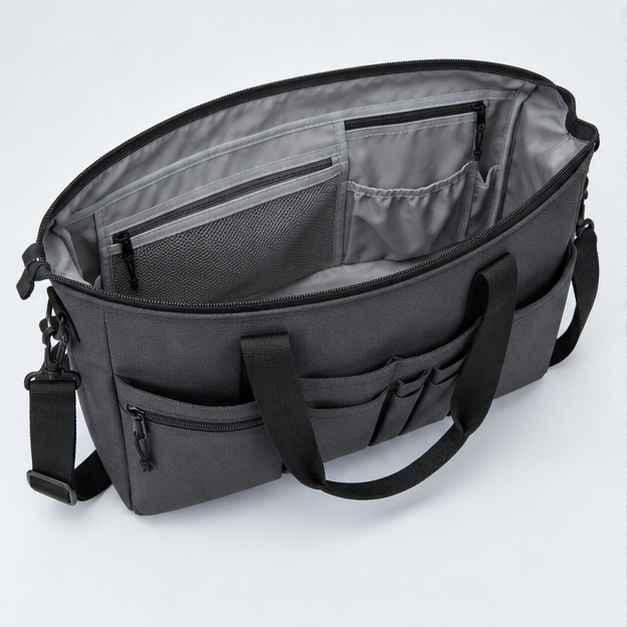
Internal organization
The main compartment and outer pockets serve different parts of a kit. Use the open view to mark divider locations and decide what should remain visible outside.
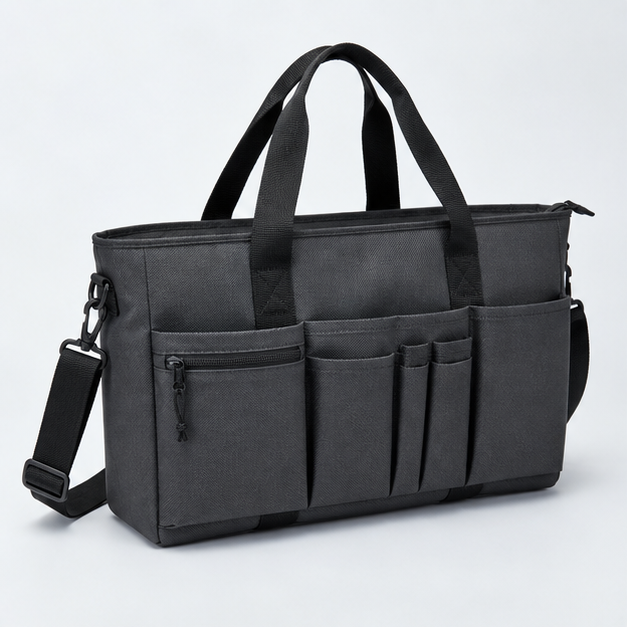
- External utility pockets
- Structured base
- Internal dividers
Multi-Pocket Utility Tote · Workwear brands and equipment-organizer procurement
Design reference for customization; final details subject to sampling.
Made-to-order B2B production. Specifications are confirmed through sampling.
An OEM multi-pocket utility tote for workwear brands and equipment-organizer programs. Lay out the actual items first, then define pocket sizes, divider positions and the supported base.
Use the interior and detail views to discuss your changes.
The main compartment and outer pockets serve different parts of a kit. Use the open view to mark divider locations and decide what should remain visible outside.
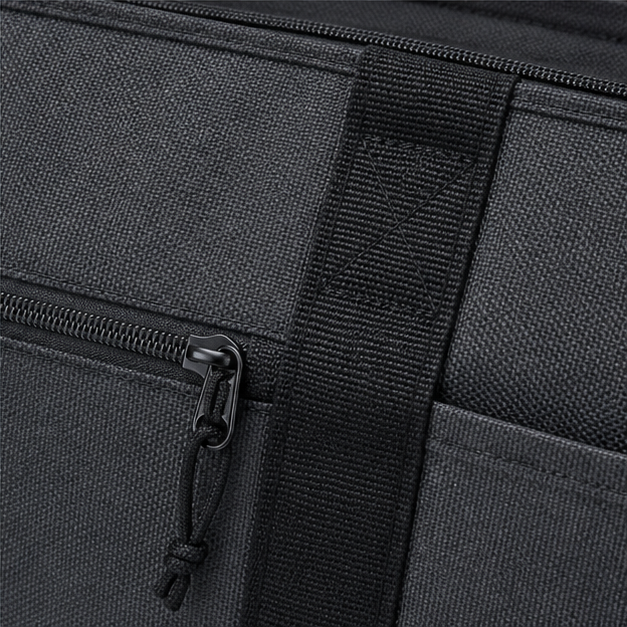
Review body fabric, handle material and finishing as one combination. Fabric weight and reinforcement affect both the shape and the way the tote folds.
Reference visuals, not production approval. Features, construction and any performance requirement must be confirmed on your sample.
MATERIAL BUILD
The listed materials are the starting direction for Multi-Pocket Utility Tote. Review the shell, inside finish and support together before approving the production specification.
Reference direction600D polyester
The 600D polyester direction should be reviewed at external pocket edges and the base. Confirm backing and color before choosing contrasting webbing.
Reference direction210D lining
The 210D lining and any dividers need to suit the stored equipment. Confirm pocket seams and binding where dividers meet the tote body.
Reference directionTo be defined with your sample
A structured base changes both standing shape and packed thickness. Decide whether the base component is fixed or removable during development.
The close-up belongs to this design reference. It does not verify fiber composition, coating, recycled content or performance.
Tell us what should stay, what should change and which details matter most to your program. Options below are discussion points, not a fixed configuration.
FUNCTIONAL DETAILS
Use these checks to turn the Multi-Pocket Utility Tote reference into a clear development brief.
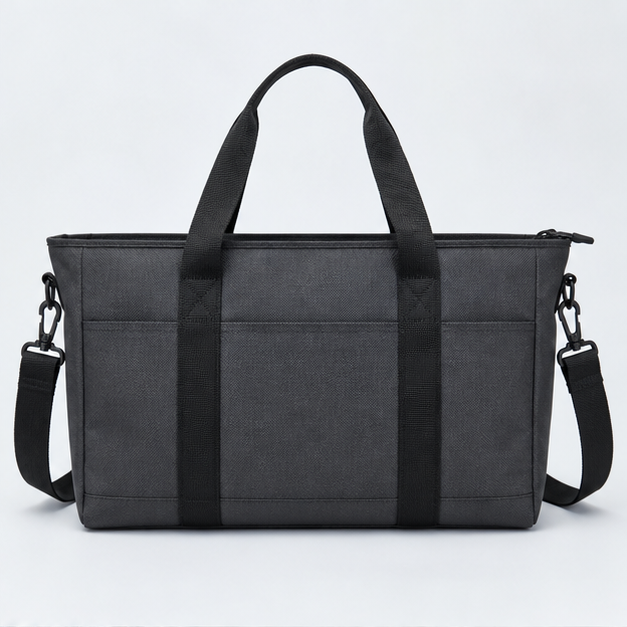
Pocket width and depth should follow the actual equipment. Adding pockets can reduce the uninterrupted area available for branding.
Buyer questionWhich items belong outside the main compartment?
Decide which spaces must stay separated and whether divisions are fixed. Check that the user can reach the bottom of each section.
Buyer questionWhat needs to remain upright or apart?
Review standing shape and handle position with the real load. A stable empty sample does not establish how the loaded tote will behave.
Buyer questionHow will the tote be set down and carried?
Discuss changes before the pattern is finalized. The pictured configuration is not the final specification for your order.
YOUR DEVELOPMENT PROCESS
A practical sequence for developing Multi-Pocket Utility Tote, with a clear input and review point at each stage.
SamplingTypically 7–10 days
Bulk productionTypically 30–45 days after approvals
Timing is a planning reference, subject to the agreed specification, material availability, revisions and production schedule.
Fill the outer pockets and main compartment together to check balance, access and standing shape.
Define which items need internal dividers and which belong outside; avoid pocket counts that do not serve the kit.
Check artwork size, position, color, label wording and packing. Sign off the final specification and sample together before bulk production.
Beverage brands, presentation programs and divided-carrier procurement
Reference sizeSpecified to the project brief
View designConference organizers, event agencies and delegate-kit procurement
Reference sizeSpecified to the project brief
View designTravel-brand and corporate promotional procurement
Reference size42 × 36 × 12 cm
View design